
Your Essential Guide to the Battery Rechargeable 18650
Posted by Chris on
So, what exactly is a battery rechargeable 18650? The name might sound a bit technical, but it’s actually just a simple description of its size: 18mm across and 65mm long. These little powerhouses are a specific type of lithium-ion cell, and they've become the go-to choice for high-drain devices, especially in the vaping world. They strike that perfect balance between size, capacity, and sheer power output.
Your Guide to Getting the Most Out of 18650 Batteries
Welcome! If you're looking to understand the battery that powers your vape, you've come to the right place. Think of this as your personal walkthrough for navigating the world of vape batteries with confidence. Getting the right power source is a huge deal for both safety and performance, but let's be honest—it can feel a little overwhelming at first.
That’s exactly why we’ve launched our new line of high-performance, thoroughly tested 18650 batteries. We wanted to cut through the noise and provide a curated selection of reliable cells for vapers all over the GTA.
What We’ll Cover
This guide is here to break down everything you need to know about the 18650 rechargeable battery. We’ll cover the tech specs, the absolute must-know safety tips, and how to pick the perfect cell for your setup from our new collection.
Our mission is pretty simple. We want to give you practical, easy-to-digest info so you can do two things:
- Vape Safely: Get a real handle on the risks and learn how to avoid them with smart battery care.
- Get the Best Performance: Find out how to match the right battery from our new product page to your device and vaping style for a truly top-tier experience.
This isn't just about selling batteries. It’s about giving our community the knowledge to make smart, safe choices. A well-informed vaper is a safer vaper, period.
We’re going to translate the complicated stuff into plain English, so you’ll feel totally comfortable whether you're buying your first external battery or you're a seasoned pro. By the time you're done reading, you'll see why not all 18650s are the same and know exactly how to pick a quality cell from our new lineup that you can count on. Let's get into it.
What Every Vaper Should Know About 18650 Specs
If you’ve ever looked at a rechargeable 18650 battery, you've seen that jumble of letters and numbers on the wrap. It might look like a foreign language, but it's actually a pretty simple code to crack, and understanding it is key to vaping safely and getting the performance you want.
First off, the name "18650" is just a boring measurement: it means the battery is 18mm wide, 65mm long, and the "0" tells you it's a cylinder. Easy enough. But the real story—the specs that actually matter for your vape—are the other numbers printed on the side.
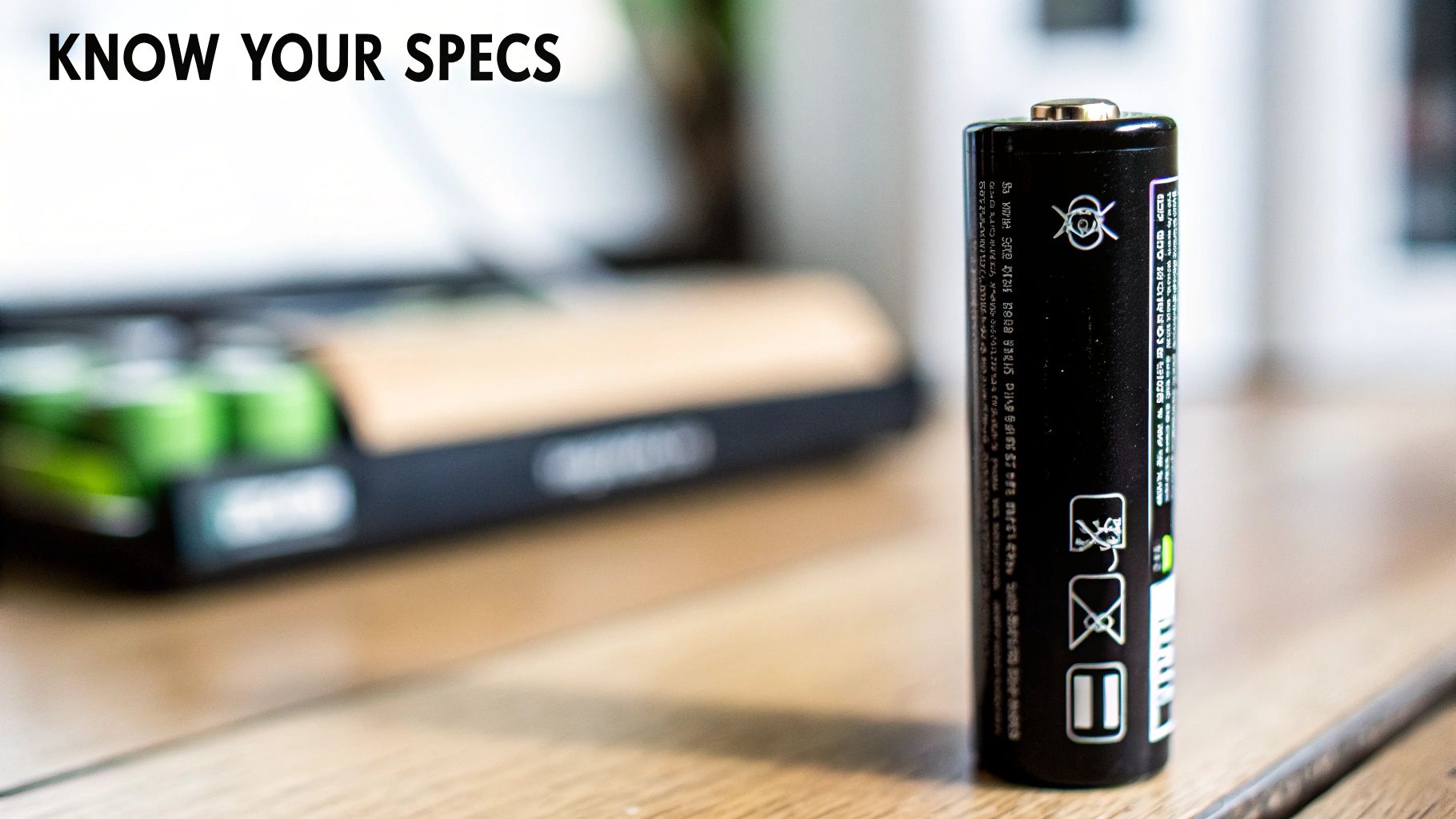
Decoding Capacity and Power
Let's break down the two most important ratings you'll find.
Think of mAh (milliampere-hours) as your battery's fuel tank. A bigger number, like 3000mAh, means it holds more juice and will last longer before you need to recharge it. If you're a pretty casual vaper who sticks to lower wattages, a high-mAh battery will probably get you through the entire day.
Then you have the Continuous Discharge Rating (CDR), often just called the "amp limit." Pay close attention to this one—it’s the single most important number for your safety. Imagine the CDR is the speed limit for your battery. If your vape mod needs to pull 20 amps (20A) to fire a coil, your battery must have a CDR of at least 20A. No exceptions.
Pushing a battery past its CDR is like flooring it in first gear for miles. It creates a ton of heat, which can damage the cell and, in a worst-case scenario, lead to thermal runaway. That's why we’ve carefully chosen the new products on our page to include only cells with genuine, accurately stated CDRs—so you can vape with confidence.
Understanding Battery Chemistry
The stuff inside a rechargeable 18650 battery—its chemistry—is what dictates how it behaves. For vaping, we almost exclusively use "safer chemistry" types that are designed to handle the high demands of a vape mod. You'll mainly run into two kinds:
- IMR (Lithium Manganese Oxide): These are the workhorses of the vape world. They're built tough and can handle high-current demands without breaking a sweat (or overheating) like older types of batteries. A very solid and reliable choice.
- INR (Lithium Manganese Nickel): Think of these as a hybrid. INR cells mix the safety and high-drain power of IMR with the higher capacity found in other chemistries. This balance makes them the go-to for many vapers.
We favour IMR and INR chemistries because they are far more stable and fail more gracefully if something goes wrong. They’re the foundation of any good, safe vape setup.
The new products we've added to our store focus exclusively on these proven IMR and INR chemistries. We prioritize cells that deliver a great balance of high-drain performance and stable chemistry, which is essential for a safe vaping experience.
To help you keep it all straight, here’s a quick cheat sheet comparing the common battery chemistries you'll encounter.
18650 Battery Chemistry Cheat Sheet for Vapers
| Chemistry Type | Primary Pro | Primary Con | Best For |
|---|---|---|---|
| INR | Excellent balance of high capacity and high discharge rating. | Can be more expensive than other types. | The majority of regulated and mechanical vape mods. |
| IMR | Very stable and safe chemistry that handles high heat well. | Typically has a slightly lower capacity (mAh) than INR. | High-wattage vapers who prioritize safety and power. |
| ICR (Lithium Cobalt Oxide) | Very high energy density (high mAh). | NOT FOR VAPING. Volatile chemistry that is unsafe for high-drain use. | Low-drain devices like flashlights or laptops. |
As you can see, choosing the right chemistry is a big deal. Sticking with proven INR or IMR batteries from a trusted source is the best way to ensure your rechargeable 18650 battery is up for the job and will keep you vaping safely.
Protected vs. Unprotected Batteries: A Critical Choice
When you're picking out a rechargeable 18650 battery, you'll hit a fork in the road right away: protected or unprotected? It sounds simple, but the difference is massive, especially when it comes to vaping. Getting this right isn't just a suggestion—it's non-negotiable for keeping you and your vape mod safe.
The Bodyguard Inside: Protected Batteries
A protected 18650 battery comes with a tiny electronic circuit board built right into the cell, usually tucked away at the bottom. Think of it as a personal bodyguard, constantly on watch to make sure the battery behaves itself.
This little guardian provides a fantastic safety net, stepping in to prevent common problems that could otherwise spell disaster. It's programmed to cut the power instantly if it senses something is wrong.
Its main jobs are:
- Over-Charge Protection: It won't let the battery charge past a safe voltage, which can cause serious damage.
- Over-Discharge Protection: It stops the voltage from dropping too low, which can also kill the battery for good.
- Short-Circuit Protection: If a short happens, the circuit slams on the brakes to prevent a dangerous thermal runaway.
This all sounds great, but there’s a catch for vapers. That bodyguard circuit severely limits the battery’s Continuous Discharge Rating (CDR), which is just a fancy way of saying its maximum power output. For a flashlight or a portable radio, this is perfect. But vape mods are power-hungry and often need way more amps than these circuits can handle, meaning a protected battery usually won't even fire your device.
The Raw Power of Unprotected Batteries
An unprotected 18650 battery is exactly what it sounds like—a raw battery cell with no built-in safety circuit. This is its biggest advantage and, at the same time, its greatest risk.
Without that circuit board getting in the way, an unprotected cell can unleash the high current you need for those demanding sub-ohm coils. This direct-to-the-metal power is precisely why the vaping world almost exclusively uses unprotected IMR or INR batteries. The performance is just in a different league.
By ditching the internal "bodyguard," the responsibility for safety lands squarely on your shoulders. Your vape mod's chipset acts as the first line of defence, but your knowledge of proper battery handling is what truly keeps you safe.
This is why our new lineup is all about high-quality, unprotected cells. We're giving experienced vapers in the GTA the power and performance they're looking for by adding these tested products to our page.
With an unprotected rechargeable 18650 battery, you are in full control. That means understanding battery safety isn’t just a good idea—it’s an absolute must for a safe and enjoyable vape.
Mastering Everyday Battery Safety and Care
Alright, let's get to what is easily the most important part of this entire guide. All the technical specs in the world don't mean much if we don't handle these batteries correctly. Proper safety and care for your rechargeable 18650 battery isn't just a good idea—it's non-negotiable for vaping safely.
Think of it like checking the oil in your car. These are simple, routine habits that prevent catastrophic failures down the road and keep your gear running smoothly and safely. Getting these basics down means you can vape with total peace of mind. Let’s walk through the essential practices every vaper in the GTA should make second nature.
The Golden Rule: Use an External Charger
I know, I know—your mod has a USB port right on it. Super convenient, right? Well, you should really only use that for firmware updates or in a real pinch. For day-to-day charging, it's a habit you want to avoid.
Charging batteries inside your mod is a recipe for trouble. For starters, the onboard charging circuits are often pretty basic and can struggle to charge multiple batteries evenly, creating a dangerous imbalance over time. It also generates a ton of heat right where all the sensitive electronics of your mod live, which is never a good thing.
A dedicated external charger is the only way to go. These are specifically designed to charge your cells safely and efficiently, with features that protect your batteries and extend their life. Seriously, grabbing a good charger is the best investment you'll make for your whole setup. You can check out some great options here: high-quality external chargers.
Your Pocket Is Not a Battery Case
This one is a hard and fast rule, with zero exceptions. Never, ever carry a loose 18650 battery in your pocket, your bag, or anywhere it can bump into metal objects. Things like keys, loose change, or even a paperclip can instantly bridge the positive and negative terminals, creating a dead short.
A short circuit causes a battery to heat up incredibly fast and vent hot, dangerous gases. This process is called "thermal runaway," and it's the number one cause of battery accidents. The good news? It is 100% preventable.
A cheap plastic battery case is an absolute must-have. It keeps the battery isolated so its terminals can't make contact with anything conductive. This tiny, simple habit is probably the single most important safety step you can take.
Inspect Your Battery Wraps Religiously
That colourful plastic sleeve on your rechargeable 18650 battery isn't just for looks. It's a vital safety component called a wrap. This thin PVC layer is the main insulator, preventing the entire metal body of the battery (which is the negative terminal) from shorting out against your device.
Even a tiny nick or tear in that wrap can expose the metal can underneath. If that exposed part touches the inside of your mod, it can create a short circuit and a very bad day.
Get into the habit of giving your batteries a quick visual inspection every single time you handle them. Look for:
- Nicks or Cuts: Check the top and bottom edges carefully, as that's where they usually get damaged.
- Peeling or Flaking: If the wrap is starting to lift or come undone, it’s time to fix it.
- Punctures: Any hole, no matter how small, is a serious safety risk.
If you spot any damage, stop using that battery immediately. Thankfully, re-wrapping batteries is incredibly easy and costs next to nothing.
Why You Must Marry Your Batteries
If your device uses two or more batteries, you need to "marry" them. This simply means you buy them as a set, you only ever use them together, and you always charge them together. For their entire lives, they are an inseparable team.
Think of it like a rowing team. You need every member to be pulling with the same strength. If one is weaker, it throws the whole boat off balance. It’s the same with batteries. When used and charged separately, they’ll eventually have different capacities and internal resistance.
When you put these mismatched cells into a device, one battery will drain faster and work harder than the other. This imbalance puts a massive strain on both cells, quickly degrading their health and creating a serious safety hazard. By keeping your batteries married, you ensure they work in perfect harmony, which is safer and makes them last much longer.
Choosing the Best 18650 From Our New Collection
Alright, you've got the safety fundamentals down, so let's get to the exciting part—picking the perfect power source for your vape from our new collection. When you're looking at a battery rechargeable 18650, it all comes down to a classic trade-off: capacity (mAh) versus power output (CDR).
Think of it like choosing a car engine. You can’t have a massive fuel tank for cross-country trips and a supercharged engine built for the racetrack in the same vehicle. You have to pick one to prioritize. The same is true for 18650 batteries. A cell with a ridiculously high mAh will have a lower CDR, and a powerhouse with a massive CDR will have a smaller "gas tank."
What's best for you? It's all about how you vape.
High-Power Vaping? High CDR Is Your Priority
If you're a cloud chaser who lives for high-wattage, sub-ohm builds, then your number one concern has to be a high Continuous Discharge Rating (CDR). Your setup is thirsty for power, pulling a lot of current in short, intense bursts. You need a battery that can handle that demand without breaking a sweat—or worse, overheating.
For this style, you should be looking for batteries with a CDR of at least 20A. You might trade a bit of battery life (mAh), but what you gain is crucial: the confidence that your cell can safely deliver the amperage your mod is asking for. Trying to run a high-wattage device on a low-CDR battery is one of the quickest ways to run into serious trouble.
Low-Wattage Vaping? Go for Higher Capacity
On the flip side, maybe you prefer a more relaxed, mouth-to-lung (MTL) vape at lower wattages. If that’s your style, your mod's power demands are much more modest. This is great because it means you can prioritize a higher capacity (mAh) to get more vaping time out of a single charge.
Since you aren't redlining the battery, a lower CDR of around 10A to 15A is perfectly safe. This allows you to grab a cell with a hefty mAh rating, like 3000mAh or even more. That means more puffs and less time tethered to a charger. A prime example of a reliable, high-capacity cell is the Samsung INR18650-30Q with 3000mAh—it’s a workhorse for MTL vapers.
The bottom line is simple: match the battery to your habits. High-wattage vapers need a high CDR, no exceptions. Low-wattage vapers can safely aim for a higher mAh for longer life. Never, ever risk your safety by using a low-amp battery for a high-power setup.
To take the guesswork out of it, we've put together a quick guide to help you find your perfect match from the new products on our page.
Which New 18650 Battery Is Right for You?
Take a look at your vaping style and see which of our new batteries is the ideal fit to power your day.
| New Battery Model | Best For Vaping Style | Key Spec (CDR) | Key Spec (mAh) |
|---|---|---|---|
| PowerCell Pro 25R | High-Wattage & Sub-Ohm | 20A | 2500mAh |
| Enduro Max 35E | Low-to-Mid Wattage & MTL | 10A | 3500mAh |
| Hybrid VTC5A | All-Round Performance | 25A | 2600mAh |
| Stealth MTL 30Q | Mouth-to-Lung & Pod Mods | 15A | 3000mAh |
Hopefully, that chart makes it crystal clear. Now, there's one last crucial thing to cover.
How to Spot a Counterfeit Battery
As you start shopping, you absolutely need to know how to spot a fake. The market is unfortunately filled with counterfeit and re-wrapped batteries that have dangerously exaggerated ratings.
Your best defence is to always buy your battery rechargeable 18650 from a reputable, trusted vape shop. If a deal seems too good to be true, it is. Period. When you get a new battery, give the wrap a close look. The printing should be crisp and clear, and the branding should perfectly match the official designs from manufacturers like Sony, Samsung, or LG. Fakes often have blurry text, slightly off colours, or flimsy, cheap-feeling wraps.
This simple flowchart is a great mental model for the very first physical check you should always do: inspecting the wrap.
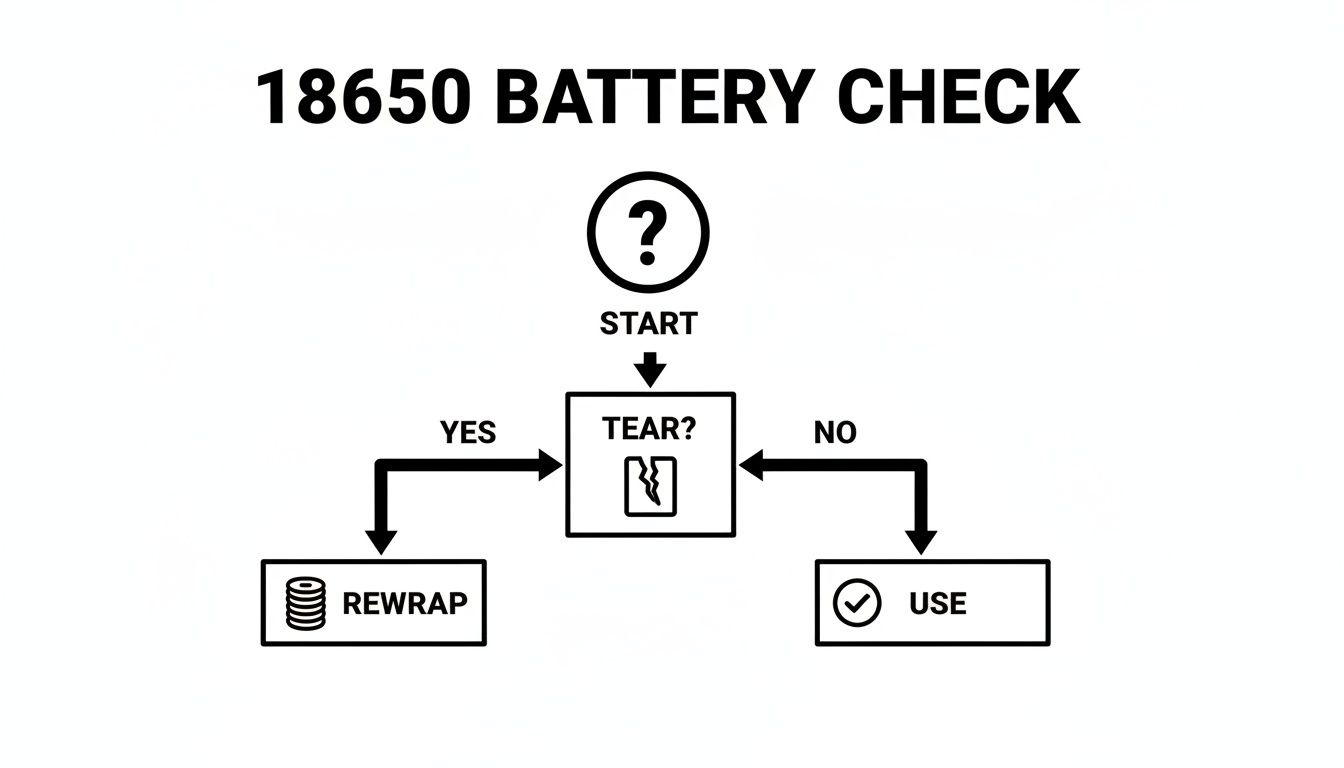
As you can see, if you spot even a tiny nick or tear, the next step is always to rewrap the battery. Never use a battery with a damaged wrap.
Looking After Your Vape Batteries from Start to Finish
Thinking about your battery rechargeable 18650's journey is a bit like owning a car. You don't just drive it until it stops; you maintain it. Proper care from the very first charge all the way to its final disposal is what guarantees safety, peak performance, and a long, useful life. Nailing these habits from the get-go means you can vape with confidence and protect your gear.
Smart Charging and Storing Habits
How you treat your batteries when they're not in your vape is just as important as when they are. The golden rule of charging? Never, ever leave them charging overnight or unattended. It's a simple habit that costs nothing and eliminates a huge amount of risk. Just keep an eye on them and pull them off the charger as soon as they’re full.
Storage is the other half of the equation. When your batteries are taking a break, they need a safe spot. That means a cool, dry place away from direct sunlight. But the most crucial part is a dedicated protective case. A good plastic case stops the battery terminals from accidentally touching your keys, loose change, or any other metal in your pocket, which could cause a catastrophic short circuit. For a couple of bucks, something like this dual 18650 black battery case is non-negotiable for safety.
Think of a battery case as its own little insulated room. It keeps the battery safe from the outside world and prevents it from causing any trouble. It's a tiny investment for total peace of mind.
Knowing When It's Time for Retirement
Your 18650s won't last forever. After hundreds of charges and discharges, their internal chemistry just wears out. It’s not a sudden breakdown, but more of a slow fade you'll definitely start to notice.
Keep an eye out for these tell-tale signs that a battery is ready for retirement:
- It Dies Too Fast: The most obvious clue is that it just doesn't hold a charge like it used to. If you’re constantly reaching for the charger, the battery's capacity is likely fading.
- It Takes Forever to Charge: An old battery can take way longer than normal to get back to 100%.
- It's Getting Hot: If you notice a battery getting unusually warm while charging or even during use, that's a serious red flag. It means its internal resistance is climbing, and it's time to stop using it immediately.
Once you spot these symptoms, pull that battery from your rotation for good. Pushing a worn-out cell is just asking for trouble, putting stress on the battery and your device.
Responsible Recycling in the GTA
So, what do you do with that old battery rechargeable 18650? The one thing you absolutely must never do is toss it in the garbage. Lithium-ion batteries are a major fire hazard in waste collection trucks and recycling facilities if they get punctured or damaged.
Proper, responsible recycling is the only way to go. For all of us in the Greater Toronto Area, it’s actually pretty easy to do the right thing. You’ve got a few great options for getting rid of your old vape batteries safely.
Here’s how to do it locally:
- City of Toronto Drop-Off Depots: These depots are specifically set up to handle hazardous materials, which includes all lithium-ion batteries.
- Local Retail Drop-Offs: Many big-box electronics and home improvement stores across the GTA have battery recycling bins right at the front entrance.
- Call2Recycle Locator: This is a fantastic online tool that lets you plug in your postal code and find the closest battery drop-off point to you.
Taking a few extra minutes to recycle your old batteries correctly is a simple step that helps keep our communities and the environment safe.
Got Questions About 18650s? We’ve Got Answers.
Let's tackle some of the most common questions we hear from vapers around the GTA about the rechargeable 18650 battery. Getting clear, straightforward answers is the key to staying safe and getting the most out of your vape.
How Long Will My 18650 Battery Last?
A good quality 18650 battery that’s been well looked after should give you about 300 to 500 charge cycles. You don’t have to sit there counting every single time you plug it in, though. Your battery will give you some pretty obvious hints when it’s getting old.
You’ll know it’s time for a replacement when it just doesn't seem to hold a charge like it used to, or maybe it takes forever to fully charge up. Those are the classic signs that its internal chemistry is starting to wear out.
Can I Use Just Any 18650 In My Vape?
No, and this is a big one. Please don't. Vaping mods are what we call "high-drain" devices, meaning they pull a lot of power very quickly. They need batteries built specifically for that kind of stress, which means you should only be using unprotected IMR or INR cells from brands you trust.
Never, ever use a rechargeable 18650 battery that you've pulled out of an old laptop battery pack, a power tool, or any other gadget. Those batteries weren't designed for the intense demands of vaping and using them in your mod is a serious safety risk.
Using the wrong type of battery is one of the biggest dangers in vaping. Always buy your batteries from a dedicated vape shop that you know gets authentic, high-drain cells made for devices like yours.
What’s This “Thermal Runaway” I Keep Hearing About?
Thermal runaway sounds scary, and it is. It's basically a chain reaction inside the battery where it overheats uncontrollably. It's the absolute worst-case scenario, but the good news is that it’s almost always preventable if you just follow the basic safety rules.
You can steer clear of it by sticking to the best practices we've talked about in this guide:
- Always use authentic, top-quality batteries.
- Make sure your battery wraps are in perfect condition, with no nicks or tears.
- Never let your batteries get short-circuited—a plastic case is your best friend here.
- Use a proper external charger, not the USB port on your mod.
Following these simple steps is the best thing you can do to keep your vaping experience safe and sound.
Ready to power your vape with batteries you can trust? At Wii Vape, we stock only the best 18650s from top-tier brands, so you know you're getting the performance and safety you need. Check out our new collection and get same-day delivery right here in the GTA. Find your perfect power source at https://www.wiivape.ca.